In today’s hyper-competitive supply chain ecosystem, inventory visibility is no longer a back-office function — it is a strategic growth driver.
Warehouses, logistics companies, manufacturers, retailers, and cold storage operators are all facing rising operational pressure to improve:
- Inventory accuracy
- Order fulfillment speed
- Asset traceability
- Dispatch efficiency
- Warehouse productivity
- Loss prevention
- Automation readiness
Even a small tracking error can lead to stockouts, delayed shipments, or revenue leakage.
This is why one critical question dominates modern operations strategy:
Should you continue with barcode systems, or upgrade to RFID tracking technology?
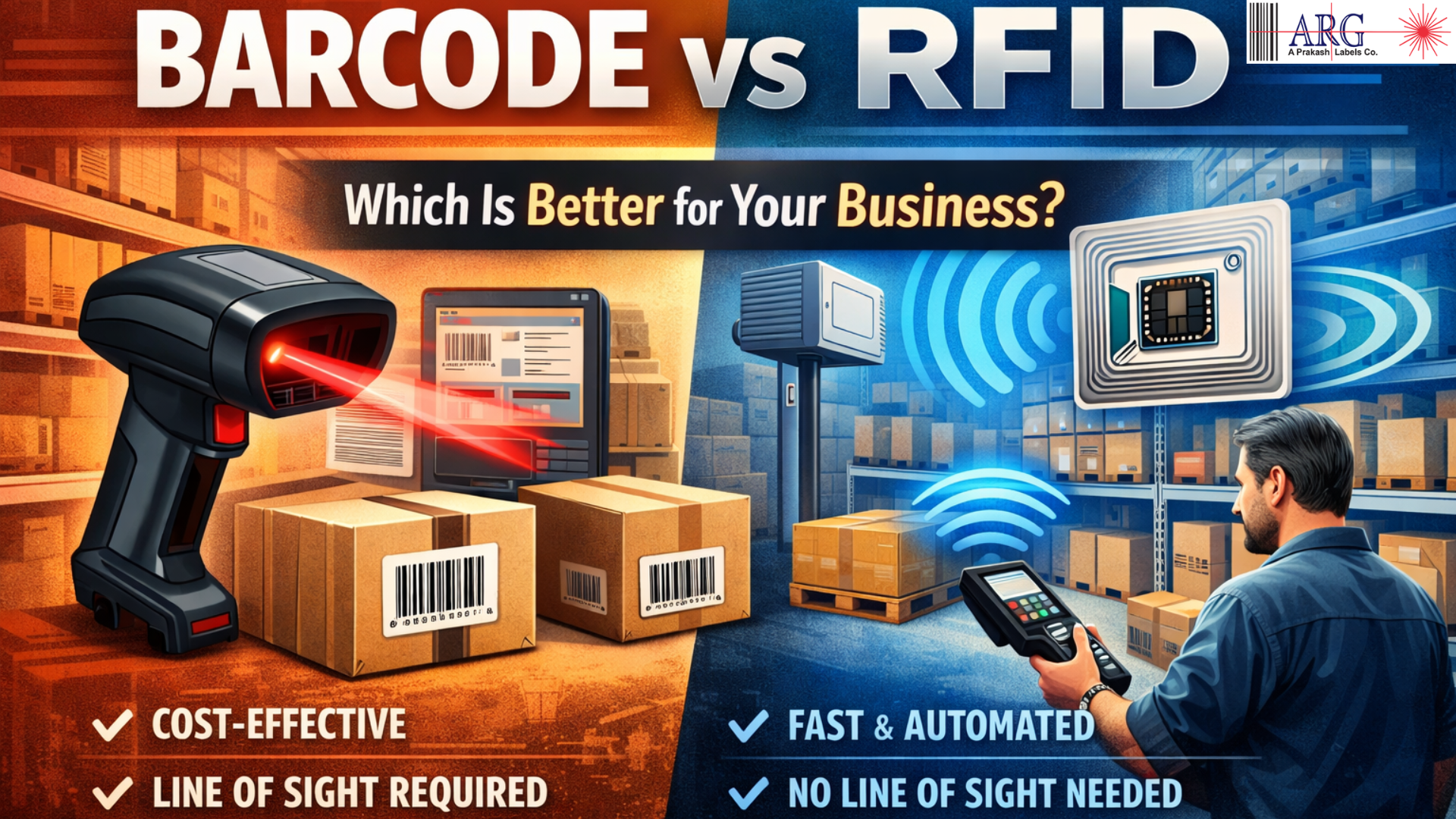
Both technologies serve the same core purpose — asset identification and inventory tracking — but their capabilities, costs, scalability, and automation potential differ significantly.
This in-depth guide compares barcode vs RFID across technology, cost, use cases, automation, and ROI — helping you make the right investment decision.
Understanding Barcode Technology
Barcode technology has been the backbone of inventory tracking for over 50 years.
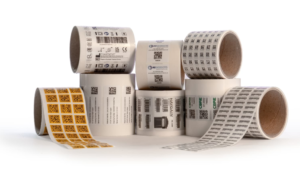
A barcode label contains machine-readable information encoded in printed black bars and spaces. When scanned using a barcode scanner, the encoded data links to backend systems such as:
- Warehouse Management Systems (WMS)
- Enterprise Resource Planning (ERP) platforms
- Retail POS systems
The system then updates stock levels instantly.
Types of Barcodes
- 1D Barcodes — UPC, EAN, Code128
- 2D Barcodes — QR codes, DataMatrix
2D barcodes store more data but still require line-of-sight scanning.
Common Uses of Barcode Labeling
Barcode systems are widely used across industries:
- Retail billing & POS
- Warehouse inventory tracking
- Shipping & courier labeling
- Manufacturing production lines
- Document tracking
- Asset tagging
Barcodes are especially effective in structured, process-driven environments.
Advantages of Barcode Systems
- Low implementation cost
- Easy to deploy
- Minimal training required
- Globally standardized
- Works with legacy systems
- Affordable consumables
For SMEs or businesses beginning digitization, barcode is the most practical starting point.
Understanding RFID Technology
RFID (Radio Frequency Identification) is a next-generation tracking technology designed for automation and real-time visibility.
RFID tags contain embedded microchips that store asset data and transmit it via radio waves to RFID readers.
Unlike barcodes, RFID does not require visual scanning.
This means:
- Items can be scanned inside cartons
- Pallets can be tracked automatically
- Bulk inventory can be counted instantly
Components of RFID Systems
A complete RFID ecosystem includes:
- RFID Tags (Passive, Active, Semi-Passive)
- Fixed or Handheld RFID Readers
- Antennas
- RFID Portals / Dock Doors
- Middleware Software
- Cloud or On-Premise Database
Together, they create a real-time tracking infrastructure.
Common Uses of RFID
RFID is widely deployed in:
- Automated warehouses
- Apparel retail chains
- Pharmaceutical logistics
- Cold storage supply chains
- High-value asset tracking
- Airport baggage systems
RFID excels in high-volume, high-speed environments.
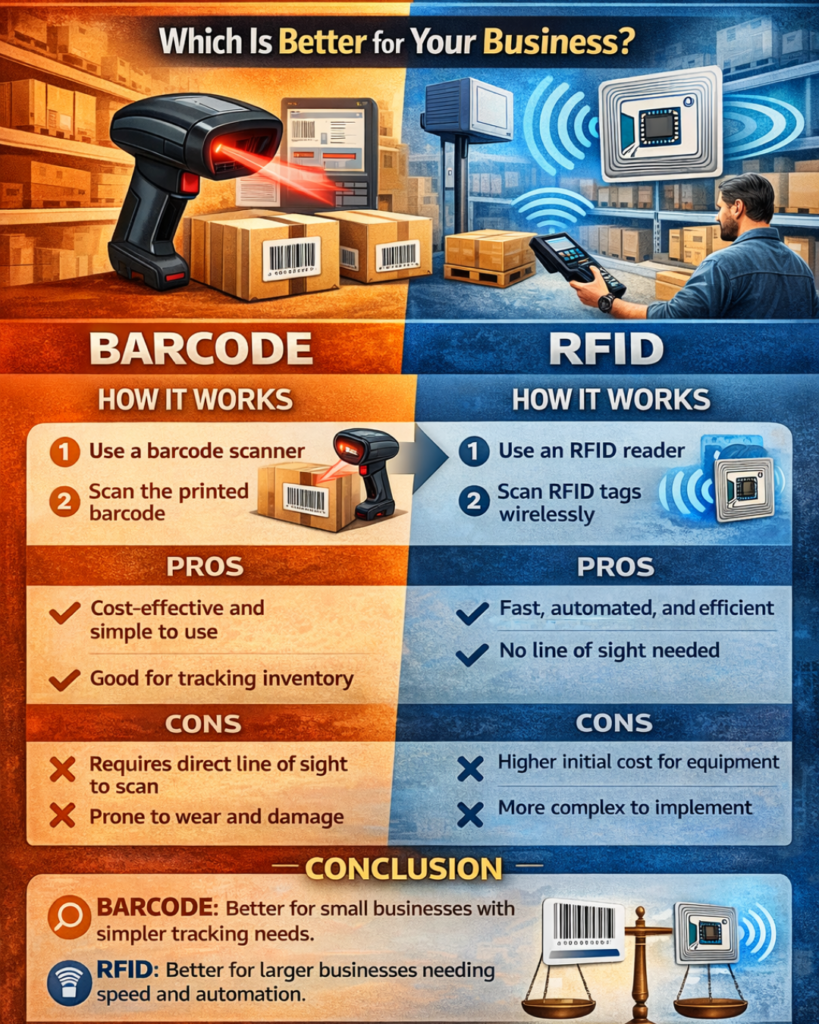
Barcode vs RFID — Technology Comparison
| Feature | Barcode | RFID |
| Scan method | Line-of-sight | Radio waves |
| Bulk scanning | Not possible | Yes |
| Scan speed | Moderate | Extremely fast |
| Automation level | Limited | Advanced |
| Human dependency | High | Low |
| Data storage | Limited | High |
| Real-time tracking | No | Yes |
Simplified View
- Barcode = Manual tracking
- RFID = Automated intelligence
Barcode vs RFID for Warehouse Management
Warehouse operations are where technology choice has the highest operational impact.
Barcode Works Best When:
- Warehouse size is small to mid-scale
- SKU volume is manageable
- Manual audits are acceptable
- Budget constraints exist
- Automation is not immediate
Barcode scanning is effective but labor-dependent.
RFID Works Best When:
- Warehouses are large or multi-location
- Real-time stock visibility is required
- Automation is planned
- Labor costs are high
- Inventory velocity is fast
RFID enables continuous, passive tracking without manual intervention.
Hybrid Deployment Strategy
Many enterprises combine both technologies:
- Barcode → Item-level labeling
- RFID → Pallet / bin / asset tracking
This balances cost and automation.
Cost Comparison — Barcode vs RFID
Cost is often the biggest decision driver.
Barcode System Cost
Typical investments include:
- Barcode labels
- Thermal printers
- Handheld scanners
- Software integration
Cost profile: Low upfront investment.
Consumables like labels are inexpensive, making barcodes budget-friendly.
RFID System Cost
RFID infrastructure requires:
- RFID tags (higher unit price)
- Fixed readers
- Handheld readers
- Antennas & portals
- Middleware software
- Installation & calibration
Cost profile: Medium to high upfront investment.
Long-Term ROI of RFID
Despite higher initial costs, RFID reduces operational expenses through:
- Labor cost savings
- Faster audits
- Fewer shipping errors
- Reduced shrinkage
- Automated compliance tracking
Large warehouses often achieve ROI within 12–24 months.
Inventory Accuracy Comparison
Inventory accuracy directly impacts profitability.
| Metric | Barcode | RFID |
| Inventory accuracy | 85–92% | 98–99% |
| Cycle counts | Manual | Automated |
| Audit frequency | Periodic | Continuous |
| Stock visibility | Delayed | Real-time |
RFID significantly reduces stock mismatches and order errors.
Cold Storage & Extreme Environment Performance
Cold storage logistics create labeling challenges.
Barcode Limitations in Freezers
- Adhesives fail in sub-zero temperatures
- Ink fades due to condensation
- Frost blocks scanner visibility
This leads to scanning failures.
RFID Advantages in Cold Chain
RFID tags are available in encapsulated formats that resist:
- Moisture
- Ice buildup
- Temperature extremes
- Chemical exposure
They enable scanning without visual contact — ideal for frozen goods and pharmaceuticals.
Role of RFID in Warehouse Automation
Automation is redefining supply chain efficiency.
RFID integrates with advanced systems such as:
- Conveyor tracking
- Automated sorting lines
- Robotic picking arms
- Smart dock doors
- IoT warehouse sensors
This creates a connected warehouse ecosystem.
Barcode systems support structured workflows but cannot enable full automation independently.
Compliance & Regulatory Tracking
Certain industries require strict traceability:
- Pharmaceuticals
- Aerospace
- Defense
- Food supply chains
RFID enables serialized tracking and automated compliance logging, improving recall management and audit readiness.
Future Trends — Inventory Tracking Beyond 2026
Businesses comparing barcode vs RFID are increasingly planning for future scalability.
Drone-Based RFID Stock Counting
Autonomous drones equipped with RFID readers scan inventory stored on high racks.
Benefits include:
- 90% faster audits
- Improved safety
- No manual lifting equipment
- Continuous stock monitoring
Blockchain-Enabled Asset Tracking
Blockchain integration with RFID creates immutable tracking logs.
Every asset movement is permanently recorded, ensuring:
- Anti-counterfeiting protection
- Supply chain transparency
- Regulatory compliance
Smart RFID Shelves
Smart shelves detect item placement and removal automatically.
They enable:
- Real-time stock updates
- Automated replenishment alerts
- Retail theft detection
AI-Powered RFID Analytics
AI tools analyze RFID data to:
- Forecast demand
- Detect shrinkage risks
- Optimize warehouse layouts
- Improve picking efficiency
This transforms tracking data into operational intelligence.
Industry Use Case Comparison
| Industry | Preferred Technology |
| Retail stores | Barcode |
| Apparel chains | RFID |
| Pharmaceuticals | Hybrid |
| Manufacturing | Barcode |
| Logistics hubs | RFID |
| Cold storage | RFID |
Technology adoption depends on scale, compliance, and automation maturity.
When Should You Upgrade from Barcode to RFID?
Businesses typically transition when they experience:
- Frequent stock mismatches
- Manual audit delays
- High labor dependency
- Asset misplacement
- Dispatch inaccuracies
- Warehouse expansion
As operations scale, barcode limitations become costlier than RFID investment.
Business Benefits of Implementing RFID
Organizations upgrading report measurable improvements:
- 10x faster inventory counts
- Real-time stock visibility
- Reduced manpower costs
- Improved order accuracy
- Lower shrinkage losses
- Faster dispatch processing
RFID enables predictive, data-driven warehouse management.
Challenges of RFID Implementation
To make this guide unbiased (and stronger than competitors), here are real considerations:
- Higher upfront investment
- Infrastructure setup time
- Signal interference (metal/liquid environments)
- Integration complexity
However, modern RFID solutions are designed to mitigate these challenges.
Barcode vs RFID — Final Verdict
There is no universal winner.
The right technology depends on operational complexity, automation goals, and budget.
Choose Barcode If:
- Budget is limited
- Operations are manual
- Warehouse scale is moderate
- Automation is not immediate
Choose RFID If:
- Automation is the priority
- Real-time tracking is required
- Warehouse scale is large
- Accuracy is mission-critical
- Labor optimization is needed
Best Practice: Hybrid Ecosystem
Most enterprises deploy a combination:
- Barcode for SKU labeling
- RFID for pallets, assets, and automation
This balances cost and scalability.
Looking to Implement Barcode or RFID?
Selecting the right tracking technology is not just an IT decision — it’s an operational transformation strategy.
We help businesses implement:
- Barcode labeling systems
- RFID tagging solutions
- Warehouse automation infrastructure
- Cold storage labeling solutions
- Asset tracking platforms
Get a Free Consultation
Planning to upgrade your inventory tracking system?
Our specialists assist with:
- Requirement assessment
- Technology selection
- Cost comparison
- ROI forecasting
- Implementation roadmap
Connect with us today to build a smarter, automated, error-free warehouse ecosystem.