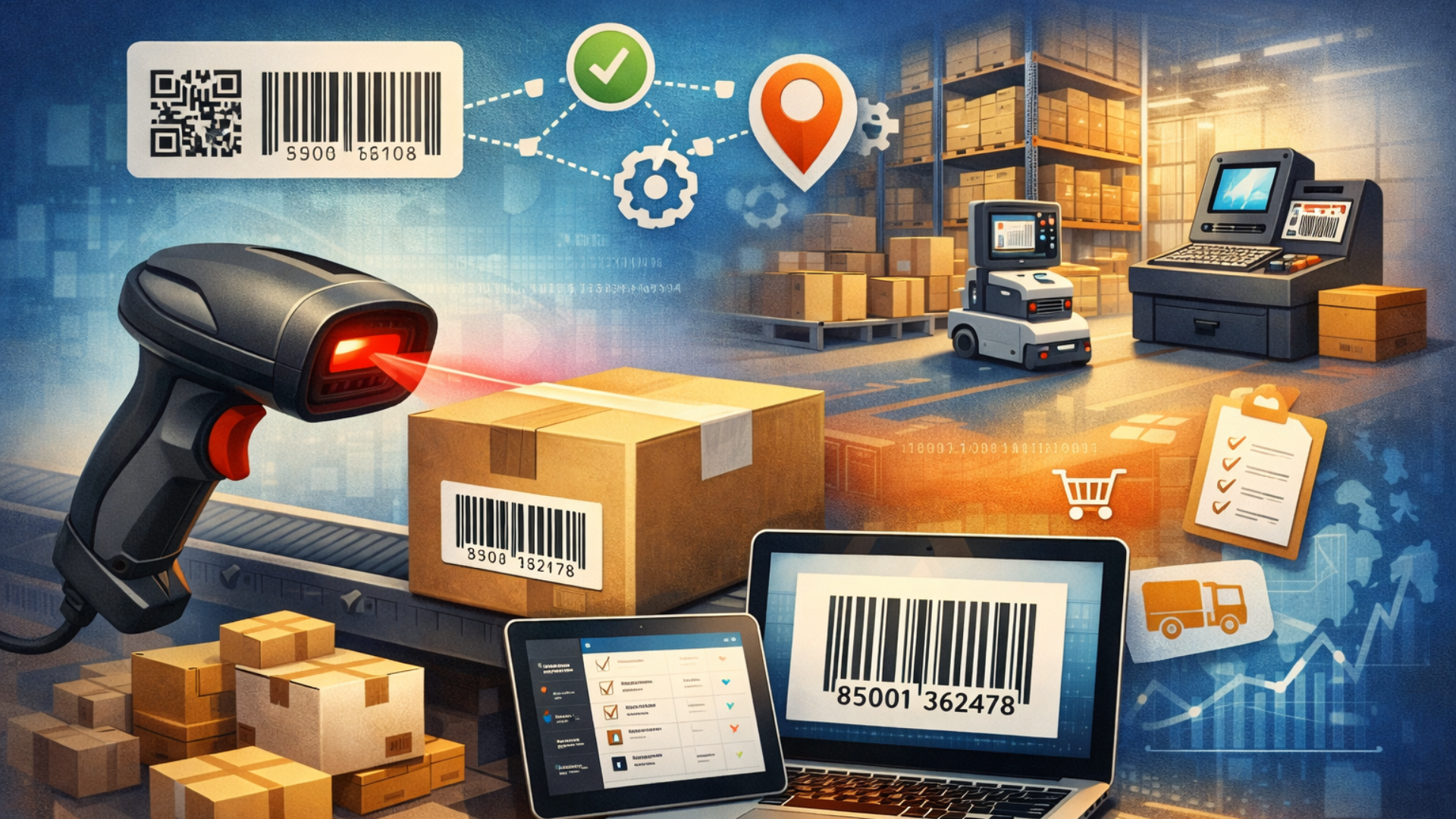
Barcodes have quietly become one of the most essential technologies behind modern supply chains. From retail shelves and shipping cartons to warehouse pallets and production lines, barcode systems help businesses identify, track, and manage products with speed and accuracy.
However, scanning barcodes alone is not enough. The real operational advantage comes when barcode scanners, printers, and mobile devices are integrated directly with ERP and Warehouse Management Systems (WMS). This is known as barcode system integration, and it plays a major role in improving inventory accuracy, operational visibility, and warehouse efficiency across industries.
Today, businesses across the UAE, Saudi Arabia, Qatar, Kenya, Nigeria, and South Africa are adopting barcode integration to modernize logistics operations and stay competitive in fast-moving supply chains.
What is Barcode System Integration?
Barcode system integration connects barcode scanning hardware with business platforms such as:
- ERP software
- Warehouse Management Systems (WMS)
- POS systems
- Inventory tracking software
- Asset management platforms
Once integrated, scanning a barcode automatically updates inventory records inside your system. This eliminates manual data entry and ensures accurate real-time information across departments.
For companies handling high product volumes or multiple warehouse locations, barcode integration becomes essential rather than optional.
Barcode System Integration with ERP
Integrating barcode systems with ERP software allows businesses to streamline operations such as inventory control, procurement tracking, shipping updates, and order processing.
When barcode scanners communicate directly with ERP platforms, warehouse teams can update stock instantly while performing routine tasks such as receiving goods or dispatching shipments.
This results in:
- improved data visibility
- reduced manual errors
- faster processing time
- better operational coordination
Before implementing barcode ERP integration, businesses should identify the key areas where automation can create the biggest impact, such as inventory management, warehouse movement tracking, or order fulfilment workflows.
Most ERP platforms today either support barcode integration directly or allow integration through middleware solutions.
Choosing the Right Barcode Technology for ERP Integration
Selecting appropriate barcode technology depends on your operational needs.
For example:
1D barcodes are suitable when tracking basic product identifiers such as retail SKUs.
2D barcodes are recommended when businesses need to store larger data sets such as:
- serial numbers
- batch details
- manufacturing information
- asset tracking references
Similarly, selecting the correct combination of scanners, printers, mobile computers, and label formats ensures smooth compatibility with ERP platforms.
Many organizations work with specialized barcode solution providers to design integration workflows tailored to their operations.
Barcode System Integration with WMS
Warehouse operations depend heavily on speed and accuracy. Without automation, inventory movement becomes difficult to manage and error-prone.
Integrating barcode systems with Warehouse Management Systems (WMS) helps automate key warehouse activities such as:
- goods receiving
- bin allocation
- picking workflows
- packing verification
- shipment dispatch tracking
Barcode-enabled warehouses operate faster and more efficiently because stock movement is recorded automatically at each stage.
For distribution centres across GCC logistics hubs and African trade corridors, WMS barcode integration significantly improves turnaround time and inventory accuracy.
Using Barcode and QR Code Technology in Warehouse Operations
Modern warehouses increasingly rely on both barcodes and QR codes to manage inventory effectively.
These machine-readable codes allow scanners to instantly capture information such as:
- SKU details
- serial numbers
- batch tracking information
- storage locations
Since scanning takes only seconds, warehouse teams can process higher volumes of inventory without increasing manpower requirements.
Benefits of Barcode and QR Code Integration in WMS
Integrating barcode technology with warehouse systems delivers measurable operational improvements.
Improved Inventory Accuracy
Barcode scanning eliminates manual entry mistakes and ensures consistent inventory data across systems.
Faster Order Processing
Automation reduces the time required for stock verification and packing operations, helping teams fulfil orders faster.
Reduced Labour Costs
Scanning replaces repetitive manual counting activities and reduces the need for large audit teams.
Better Operational Visibility
Managers can access real-time stock information, shipment status, and product tracking updates instantly.
Accurate Asset Tracking
Assigning unique barcodes to each product ensures items are never misplaced inside warehouse environments.
Scalable Warehouse Operations
Barcode automation supports both small storage facilities and large distribution centres handling thousands of SKUs daily.
Hardware Required for Successful Barcode Integration
Effective barcode implementation depends on selecting compatible hardware components.
Typical deployment environments include:
- industrial barcode scanners
- wireless handheld terminals
- mobile computers
- thermal barcode printers
- vehicle-mounted warehouse terminals
Choosing rugged hardware is especially important in warehouses exposed to dust, outdoor loading zones, or high-temperature environments common across Middle Eastern and African logistics sectors.
Step-by-Step Barcode Integration Workflow
A structured approach ensures smooth system implementation.
Most deployments follow these stages:
- Understanding operational workflows
- Selecting barcode symbology
- Planning hardware compatibility
- Configuring ERP or WMS connectivity
- Testing integration architecture
- Running pilot deployment
- Training warehouse staff
- Executing full rollout
Working with experienced integration specialists reduces deployment risks and improves long-term system performance.
Cloud vs On-Premise Barcode Integration
Businesses can choose between cloud-based and on-premise deployment depending on infrastructure requirements.
Cloud integration is ideal for organizations operating multiple warehouse locations and requiring remote access to inventory data.
On-premise integration suits manufacturing plants and secure facilities where internal data control is critical.
Both models support reliable barcode automation when implemented correctly.
Common Challenges in Barcode System Integration
While barcode integration offers major operational advantages, proper planning is essential.
Typical challenges include:
- compatibility with legacy ERP platforms
- incorrect barcode format selection
- limited wireless infrastructure inside warehouses
- lack of staff training
These challenges can be resolved through proper system design and professional implementation support.
Why Businesses in GCC and Africa Are Investing in Barcode Automation
Warehouse automation adoption is increasing rapidly across regions such as:
- UAE
- Saudi Arabia
- Qatar
- Kenya
- Nigeria
- South Africa
Key drivers include:
- growth of e-commerce fulfilment networks
- retail supply chain expansion
- manufacturing digitization
- logistics hub modernization
Barcode integration helps businesses handle increasing inventory volumes without increasing operational complexity.
Choosing the Right Barcode Integration Partner
Successful deployment depends heavily on selecting the right solution provider.
An experienced integration partner should support:
- workflow analysis
- hardware selection
- ERP compatibility planning
- custom label configuration
- system deployment
- staff training
Companies like ARG Label & Technology FZE provide tailored barcode automation solutions designed specifically for warehouse, retail, logistics, and manufacturing environments across the Middle East and Africa.
Future of Barcode Automation in Smart Warehousing
Barcode integration is increasingly becoming part of larger warehouse digitization strategies that include:
- RFID tracking
- IoT-enabled asset monitoring
- AI-based inventory forecasting
- cloud-connected scanning environments
Businesses investing in barcode integration today are building the foundation for future-ready supply chain infrastructure.
Conclusion
Barcode system integration helps organizations replace manual inventory tracking with automated, accurate, and scalable workflows. By connecting barcode scanning hardware directly with ERP and warehouse management systems, businesses can improve productivity, reduce operational costs, and maintain better control over inventory movement.
For companies operating across fast-growing logistics markets in the Middle East and Africa, barcode integration offers a reliable path toward smarter and
FAQs
Developers need to be cautious while dealing with open-source solutions, even though they may appear to be cheap. Open-source solutions may bring in a host of challenges that can slowly add to your budget over time. Challenges can include limited support, integration risks, slower updates, and failure to offer timely assistance.
Yes, your inventory management requirements play a key role in your choice of barcode system. Inventory needs, such as the exact amount of data for tracking, product types, industry-based needs, the present scanning environment, and supportive barcode types (already in use), are taken into consideration. Some industries adopt a similar set of barcode types; for example, retail packaging involves the use of UPC barcodes.
An SDK, or software development kit, refers to a tool that is used to introduce scanning features directly into your smartphone or laptop. It offers advanced inventory benefits and added control for your scanning purposes.
Employees are given extensive training to be able to use the integrated system with proper care and guidance as professionals. They are given training for knowing how to operate barcode scanners, data interpretation, troubleshooting problems and familiarising themselves with the barcode system. Such efforts provide accurate reading and improved results.