Operating a business that relies on inventory or logistics is not necessarily as easy as it may seem. A single misalignment of stock or a scan that is missed can make things go slower than anticipated. This is something that many businesses in the UAE have to deal with on a daily basis, particularly in warehouses and production settings. Due to this, RFID tracking systems, QR code scanning, and barcodes are now being taken more seriously. Nevertheless, it is always good to have a clear picture of how RFID QR code and barcode systems perform in the real working environment before making a decision.
What is a Barcode?
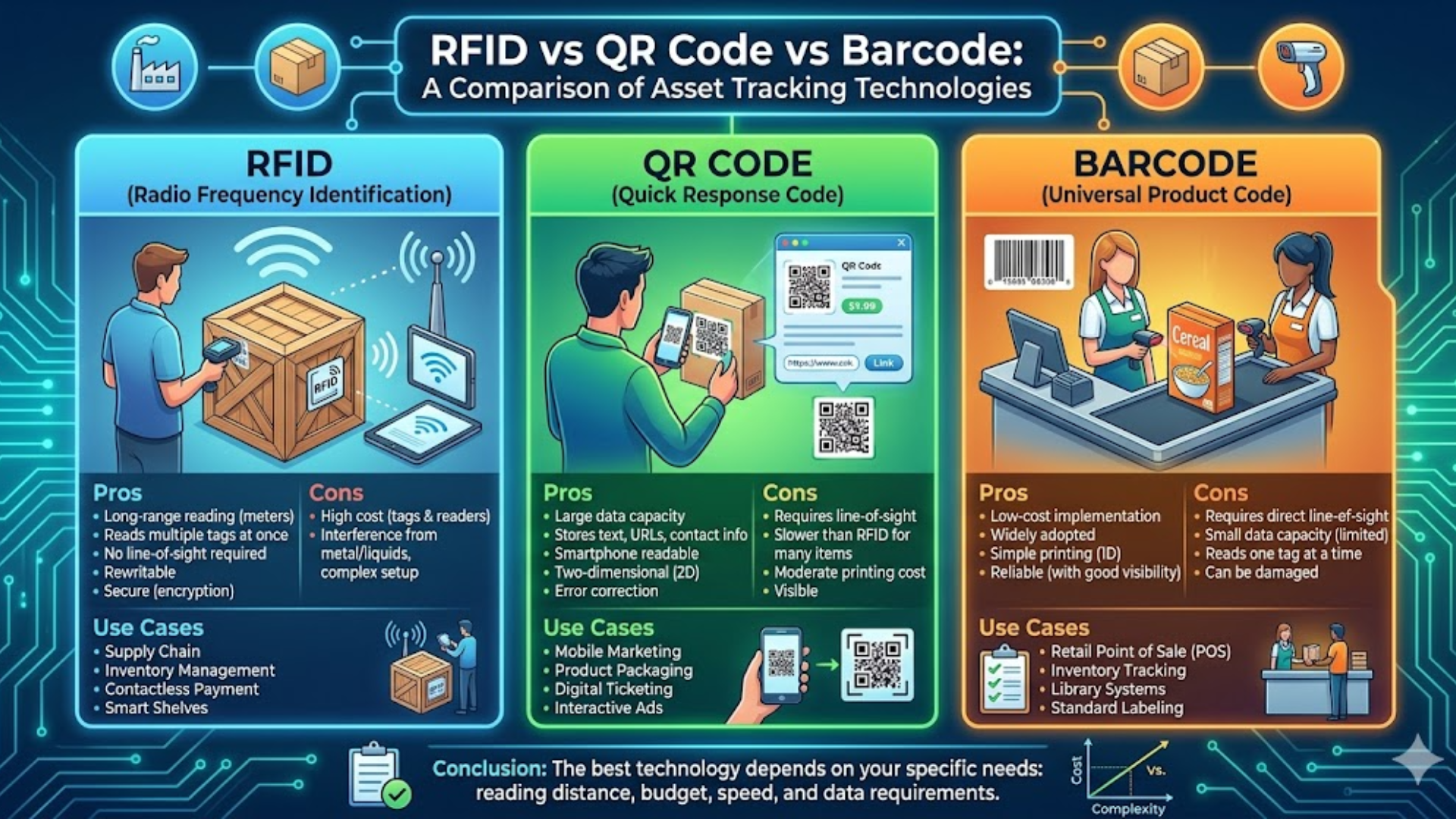
The most common one is likely to be barcodes. You can find them nearly everywhere, in retail shops and shipping boxes. A barcode is a simple label consisting of lines that contains little information and requires a scanner to read it. They are still in use by many businesses due to their simplicity and low cost. ARG Label & Technology FZE distributes barcode printers of such brands as TSC Auto ID, Printronix Auto ID, and Honeywell. With that said, there are certain obvious boundaries. Every object must be scanned individually; the memory is small, and it cannot scan in large volumes. Here is where RFID QR code options begin to gain relevance.
What is a QR Code?
QR codes are a logical extension of barcodes. They are able to store more information and do not require specialized equipment in most instances. They can be scanned even by a smartphone, which simplifies the process of daily operations. QR codes can be a good fit when considering RFID QR code solutions because they are practical and do not require heavy investment. ARG Label & Technology FZE offers various label materials including Paper, PP, PE, Silver Metalized, and Polyester, which can be used in QR.
- Can store links, product details, and basic tracking data
- Scans from different angles without needing perfect alignment
- Easy to generate and does not cost much
- Common across retail, logistics, and healthcare sectors
What is RFID?
RFID works in a completely different way. Instead of scanning each label manually, it reads tags using radio signals. This means items can be tracked without direct contact. In environments where speed matters, this can make a noticeable difference. ARG Label & Technology FZE has worked on RFID setups for warehouses and manufacturing units where manual processes slow things down. Compared to RFID QR code systems, RFID removes a lot of repetitive work.
- Can detect multiple items at once
- No need for line-of-sight scanning
- Works through packaging and stacked goods
- Suitable for high-volume and fast-moving operations
RFID vs QR Code vs Barcode: Side-by-Side Comparison
| Feature | Barcode | QR Code | RFID |
| Scan Method | Laser/optical | Camera/scanner | Radio waves |
| Line-of-Sight Required | Yes | Yes | No |
| Data Capacity | Low | Medium | High |
| Scan Speed | One at a time | Moderate | Bulk scanning |
| Cost | Low | Low | Higher upfront |
| Best For | Retail POS | Logistics, marketing | Warehouses, manufacturing |
| Rewritable | No | No | Yes (active tags) |
Which Technology is Best for Your Business?
Instead of looking for a perfect solution, it is better to match the technology with how your business actually works.
Small Retail Outlets and Garment Export Houses:
In smaller setups, QR codes usually do the job without adding complexity. They are easy to manage and cost-effective. ARG Label & Technology FZE supports this with label solutions and numbering systems that are simple to use.
Mid-Size Logistics and E-Commerce Operations:
As operations grow, tracking becomes more important. QR code scanning combined with a basic system works well here. It keeps things organized without making processes too heavy. ARG Label & Technology FZE provides tools like label applicators and thermal rolls that fit into this level smoothly.
Large Warehouses and Manufacturing Facilities:
In large environments, manual scanning slows everything down. This is where RFID makes more sense. It speeds up tracking and reduces human effort. ARG Label & Technology FZE has implemented RFID tracking systems across such environments. When businesses explore rfid qr code together, they help create a balanced system.
Why is ARG Label & Technology FZE is Your Trusted Auto ID Partner in the UAE?
Technology alone does not solve problems unless it is implemented properly. This is where experience matters. ARG Label & Technology FZE, based in Ajman Free Zone, works with brands like Honeywell, TSC Auto ID, Printronix Auto ID, TYSSO Fametech America, and Open Data SRL. They also use materials from Avery Dennison. Whether you want to build a rfid qr code setup or improve an existing system, their team has handled similar requirements before. Their work with companies like Al-Futtaim and Aster shows that they are trusted in real business environments.
Conclusion
Every business runs differently, so the right tracking method depends on your actual needs. Some benefit from simple systems, while others require automation. Taking time to evaluate this properly can save effort later. If you need guidance, working with an experienced provider can make things easier.
Looking for the right Auto ID solution for your business in the UAE? Get in touch with ARG Label and Technology FZE today and let our experts help you find the right fit.
FAQs
The primary distinction between these technologies when comparing them is the data capture and processing. Barcodes are to be directly scanned, QR codes are more flexible, and RFID is more efficient since it can track items automatically without line of sight.
QR codes and barcodes tend to be more affordable for smaller businesses. They are simple to deploy and do not need heavy infrastructure. RFID, however, is more expensive to invest in but has long-term efficiency advantages.
QR codes, in most instances, can be used in place of traditional barcodes since they have more data and are simpler to scan. Nonetheless, barcodes continue to be widely applied in basic retail stores where simple tracking is adequate.
RFID is highly prolific and does not apply to every business. It works best in large scale environments like warehouses or manufacturing plants where timeliness, automation and bulk monitoring form part of the daily operations.
Among the best advantages of QR codes, one can single out the fact that no specialised devices are required. Most smartphones can scan them easily, and this aspect renders them convenient to businesses that would like to have an easy and convenient tracking tool.
RFID tracking will be more accurate in a large volume environment because it will reduce manual scanning. It can read multiple tags at the same time, therefore minimizing the chances of scans being missed and increasing the efficiency of the entire tracking process.
Yes, there are numerous companies that integrate RFID, QR codes, and barcodes based on the company’s requirements. As an example, RFID may be applied to bulk tracking, and QR codes may be applied to product-level data, which provides a more balanced system.
QR codes are popular in retailing, logistics, healthcare, and even marketing. They are flexible and cheap, thus appropriate in businesses where fast access to product information and easy tracking procedures are required.
The transition of barcode to RFID cannot be done without planning, since it will involve the integration of new equipment and systems. But, through proper support and direction, companies can easily go through the transition and begin to experience efficiency gains.
The most effective practice is to consider the size of your business, the volume of your inventory and the objectives of your operations. Rather than taking the trends, you should select a solution that will suit your working process and be scalable as your business expands.